Other approaches
Control functions
[Placeholder: The previous GitBook contained only a heading for this topic.]
Proxy variables
When there is unmeasured confounding, one can identify \[E[Y(a)]\] with the help of proxies for the unmeasured confounder, i.e. noisy measurements of the unmeasured confounder.
-—–
Example 1 (revisited).
Let’s revisit the epidemiology problem referred to as confounding by indication, whereby healthcare providers have information about a patient’s underlying health that is not captured in the data.
Q. What might be some proxy variables for unmeasured health U?
A. Well, the variables will certainly depend on the context. But broadly, we can think of any information on a patient’s health that the care provider might collect to inform their treatment decision. Examples include
- Vitals (e.g., blood pressure, temperature)
- Lab results (e.g., lipid profile, A1C, protein levels)
- Imaging results (e.g., cloudiness in lung x-ray)
-—–
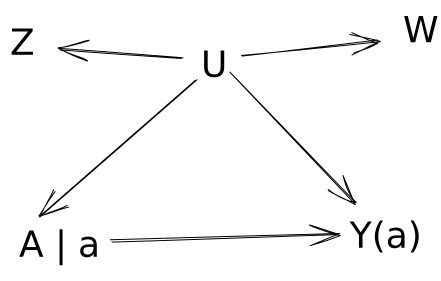
The simplest case may be when two variables \[Z\] and \[W\]can have a direct causal impact on the unmeasured variable \[U\] (i.e. \[Z \rightarrow U\] and \[W \rightarrow U\]) but not on any other variables.
We update our SWIG to look like:
How exactly does a proxy variable help?
It starts with backdoor adjustment:
\[E[g( Y(a)) ] = E[ E[ g(Y) | A=a, U] ]\]
And an assumption about variables taking on a finite number of values.
This means that
\[E[Y(a)] = \sum_y y P( Y(a)=y)\]
with
\[P(Y(a)=y) = \sum_{u} P( Y = y | U=u,A=a)P(U=u)\].
The right-hand side is expressed in terms of \[U\] which we do not measure, but remarkably, we can remove \[U\] from the expression. It requires manipulating two applications of law of iterated expectation:
\[P(W=w | Z=z, A=a)\]
\[= \sum_u P(W=w | U=u) P( U=u | Z=z, A=a)\]
\[P(Y=y | Z=z)\]
\[=\sum_u P(Y=y | U=u, A=a) P(U=u | Z=z, A=a)\]
We can then re-write \[P(Y(a)=y)\] into
\[\sum_{z,w} P (Y=y | Z=z, A=a) (\mathbb{B}^{-1})_{zw} P(W=w)\],
provided \[\mathbb{B}\] is invertible where \[\mathbb{B}\] is the matrix whose entries are given by
\[(\mathbb{B})_{wz} = P( W=w | Z=z , A = a).\]
Notice that the above expression does not involve \[U\].
Technical note. The argument involves matrix manipulations and may not be particularly illuminating, but we repeat it here.
The two expressions we recover from the law of iterated expectations are expressed in matrix form as
\[\mathbb{B} = \mathbb{C} \mathbb{D}\]
where
- \[(\mathbb{C})_{wu} = P( W=w | U=u )\]
- \[(\mathbb{D})_{uz} = P( U=u | Z=z, A=a )\]
and
\[\mathbb{E} = \mathbb{F} \mathbb{D}\]
where
- \[(\mathbb{E})_{yz} = P( Y=y | Z=z, A=x )\]
- \[(\mathbb{F})_{yu} = P( Y=y | U=u, A=x )\].
Matrix algebra then gives
\[\mathbb{F} = \mathbb{E} \mathbb{D}^{-1} = \mathbb{E} \mathbb{B}^{-1}\mathbb{C}\].
Entry-wise, this expression becomes
\[P( Y = y | U= u, A=a )\]
\[= \sum_{wz} P( Y=y | Z=z, A=a ) ( \mathbb{B}^{-1} )_{z w} P( W=w | U=u )\]
and summing over \[u\] leaves the desired result
\[P(Y(a)=y)\]
\[= \sum_u P( Y=y | U=u, A=a ) P(U=u)\]
\[= \sum_{uwz} P( Y=y | Z=z, A=a ) ( \mathbb{B}^{-1} )_{z w} P( W=w | U=u )P(U=u)\]
\[= \sum_{wz} P( Y=y | Z=z, A=a ) ( \mathbb{B}^{-1} )_{z w} P( W=w)\].
-—–
Example 2.
Consider the simplest case when all variables are binary.
Q. Use proxy variables Z and W to identify E[Y(a)]
A. In the binary case, we can make simplifications. First,
\[E[Y(a)] = P( Y(a)= 1 )\]
\[= \sum_{wz} P( Y=1 | Z=z, A=a) (\mathbb{B}^{-1})_{zw} P(W=w)\]
Since most of our expressions condition on \[A=a\], we will suppress this dependence by replacing \[P\] with \[P_a\] in an effort to simplify notation.
Second, we note that
\[\mathbb{B} = \begin{bmatrix} 1-P_a(W=1 | Z=0) & 1-P_a(W=1 | Z=1) \\ P_a(W=1 | Z=0) & P_a(W=1 | Z=1)\end{bmatrix}\]
so that
\[\mathbb{B}^{-1} = \frac{1}{|\mathbb{B}|} \begin{bmatrix} P_a(W=1 | Z=1) & P_a(W=1 | Z=1)-1 \\ -P_a(W=1 | Z=0) & 1-P_a(W=1 | Z=0)\end{bmatrix}\]where
\[| \mathbb{B} | =P_a(W=1 | Z=1) - P_a(W=1|Z=0)\]
Therefore,
\[= \sum_{wz} P( Y=1 | Z=z, A=a) (\mathbb{B}^{-1})_{zw} P(W=w)\]
\[= P_a( Y=1 | Z=0) \frac{P_a(W=1|Z=1)-P_a(W=1)}{P_a(W=1 | Z=1) - P_a(W=1|Z=0)}\]
\[+P_a( Y=1 | Z=1)\frac{P_a(W=1)-P_a(W=1|Z=0)}{P_a(W=1 | Z=1) - P_a(W=1|Z=0)}\].
References
- Kuroki, M., & Pearl, J. (2014). Measurement bias and effect restoration in causal inference.Biometrika, 101(2), 423-437.
- Miao, W., Geng, Z., & Tchetgen Tchetgen, E. J. (2018). Identifying causal effects with proxy variables of an unmeasured confounder. Biometrika, 105(4), 987-993.