Exercises
Nonidentification
1. Does measuring another variable identify the effect?
Return to the wildfire-smoke example. Let \(A=1\) mean staying indoors and \(Y=1\) mean an asthma exacerbation later that day. This time, we also observe \(X\), where \(X=1\) means the person had an exacerbation in the previous year. All three variables are binary. An unmeasured variable \(U\) may influence both \(A\) and \(Y\).
Assume the following causal graph:
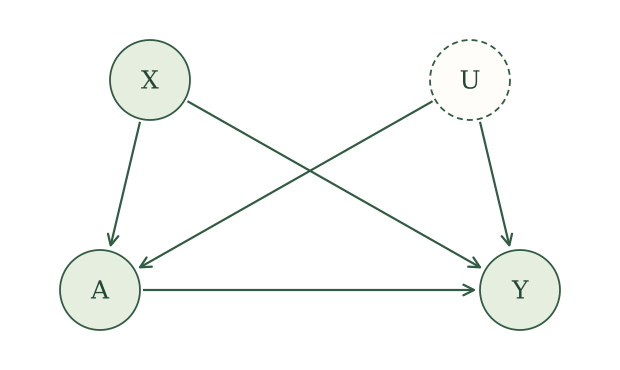
Suppose we know the following probabilities exactly:
\[ \begin{aligned} P(X=1)&=\frac12,\\ P(A=1\mid X=x)&=\frac12,\qquad x\in\{0,1\}. \end{aligned} \]
The outcome probabilities are
| \(x\) | \(a\) | \(P(Y=0\mid X=x,A=a)\) | \(P(Y=1\mid X=x,A=a)\) |
|---|---|---|---|
| 0 | 0 | \(3/4\) | \(1/4\) |
| 0 | 1 | \(1/2\) | \(1/2\) |
| 1 | 0 | \(1/2\) | \(1/2\) |
| 1 | 1 | \(1/4\) | \(3/4\) |
These probabilities determine the joint distribution of the observed variables \(X,A,Y\). Your task is to construct two SCMs that reproduce this same observed distribution but give different ATEs. Use Bernoulli assignments as in the worked example, with independent noise terms. Assignments may ignore parents in the graph.
Construct a first SCM in which \(U\) has no influence and \(A\) is independent of \(X\) and \(U\). Choose an outcome assignment that reproduces the table. Verify that your SCM also gives the stated probabilities for \(X\) and \(A\).
Construct a second SCM in which \(U\) influences both staying indoors and the outcome, but staying indoors has no effect on the outcome. Reproduce the same table and the same probabilities for \(X\) and \(A\). Hint: Try a binary \(U\) with \(P(U=1)=1/2\) and the assignment \(A\leftarrow U\).
For each SCM, derive \(E[Y(a=1)]\) and \(E[Y(a=0)]\), averaging over the variables that still affect the outcome after intervention. Calculate the ATE in each case.
Explain why these two SCMs show that the ATE cannot be identified from the observed distribution of \(X,A,Y\), even though \(X\) is measured.
Instrumental variables
For Exercises 2 and 3, use our working instrumental-variable SCM, with binary offer \(Z\), binary participation \(A\), and blood pressure \(Y\). Assume treatment relevance and monotonicity. Take \(X\) to be constant unless covariates are explicitly included. Exercise 4 asks you to assess proposed instruments rather than assume their validity.
2. The usual IV estimand and weak treatment relevance
A study randomly offers an incentive to join an exercise program. The study reports these estimated participation probabilities and mean systolic blood pressures:
| Offer | Probability of participation | Mean blood pressure (mmHg) |
|---|---|---|
| Not offered (\(Z=0\)) | 0.30 | 138 |
| Offered (\(Z=1\)) | 0.70 | 134 |
Calculate the difference in mean blood pressure and the difference in participation between the offer groups, subtracting the group with \(Z=0\) from the group with \(Z=1\).
Calculate the usual IV estimate.
Interpret the estimate as a CACE. Specify who the compliers are in this study.
Another study reports participation probabilities of 0.30 without the offer and 0.31 with it. Mean blood pressures are 138 and 137.9 mmHg, respectively. Calculate the IV estimate. Although the estimate is the same, treatment relevance is much weaker. What might happen to the estimate if sampling variability slightly changes the observed outcome difference? Explain using the denominator of the IV estimator.
3. Reading two-stage least-squares results
Let \(Z=1\) indicate an offer to join an exercise program, \(A=1\) participation, and \(Y\) systolic blood pressure at the end of the study. The fitted regressions are supplied; no model fitting is required.
a. Without covariates. The first-stage regression of \(A\) on \(Z\) gives
\[ \widehat A=0.2+0.4Z. \]
The second-stage regression of \(Y\) on \(\widehat A\) gives
\[ \widehat Y=136-10\widehat A. \]
What is the estimated causal effect of participating? Interpret the estimate, including the group to which it applies and the units.
b. With covariates. Another exercise-program study records \(X\), a binary indicator of high baseline blood pressure. The offer is randomized with probability \(1/2\) at both values of \(X\). Researchers include \(X\) in both stages.
The first-stage regression of \(A\) on \(Z\) and \(X\) gives
\[ \widehat A=0.2+0.4Z+0.1X. \]
The second-stage regression of \(Y\) on \(\widehat A\) and \(X\) gives
\[ \widehat Y=136-8\widehat A+6X. \]
What is the estimated causal effect of participating? Interpret the estimate, including the group to which it applies and the units.
4. Would you trust these proposed instruments?
Consider three studies in which treatment received may have unmeasured common causes with the outcome.
A gift-card offer. A study randomly offers some people a gift card if they join an exercise program. Participation is 55% among those offered the incentive and 35% among those not offered it. The proposed instrument \(Z\) is the offer, treatment \(A\) is participation, and outcome \(Y\) is blood pressure. People who participate can spend their gift cards however they like.
Living near a rehabilitation clinic. Researchers propose living within one mile of a rehabilitation clinic as an instrument for attending rehabilitation after a heart attack. Attendance is more common among people living nearby. The outcome is hospital readmission. Housing costs and access to other health services differ between nearby and more distant neighborhoods.
A surgeon’s prescribing preference. Researchers propose assignment to a surgeon who usually prescribes a preventive medication more often (\(Z=1\)), rather than one who prescribes it less often (\(Z=0\)), as an instrument for whether a patient receives it. The outcome is a postoperative complication. Surgeons in the first group prescribe the medication more often, but also use different postoperative care protocols. Patients are referred to surgeons partly according to the complexity of their condition.
For each study, explain how you would assess treatment relevance. What evidence is supplied, and what could be checked in the data?
For each study, discuss whether the proposed instrument could share unmeasured causes with treatment or outcome. Identify a specific possible common cause or explain how the study design addresses this concern.
For each study, describe a possible causal route from the instrument to the outcome that does not pass through treatment \(A\). Explain what this would mean for exclusion restriction.
For each study, describe what monotonicity would mean. Does greater average treatment uptake under \(Z=1\) establish monotonicity? Explain.
Choose one study and propose a useful check using observed data. Explain what the check could reveal and which concern it would leave unresolved.
Regression discontinuity
[Placeholder: Exercises to be written.]
Other approaches
[Placeholder: Exercises to be written.]