Studying Autism with Causal Inference
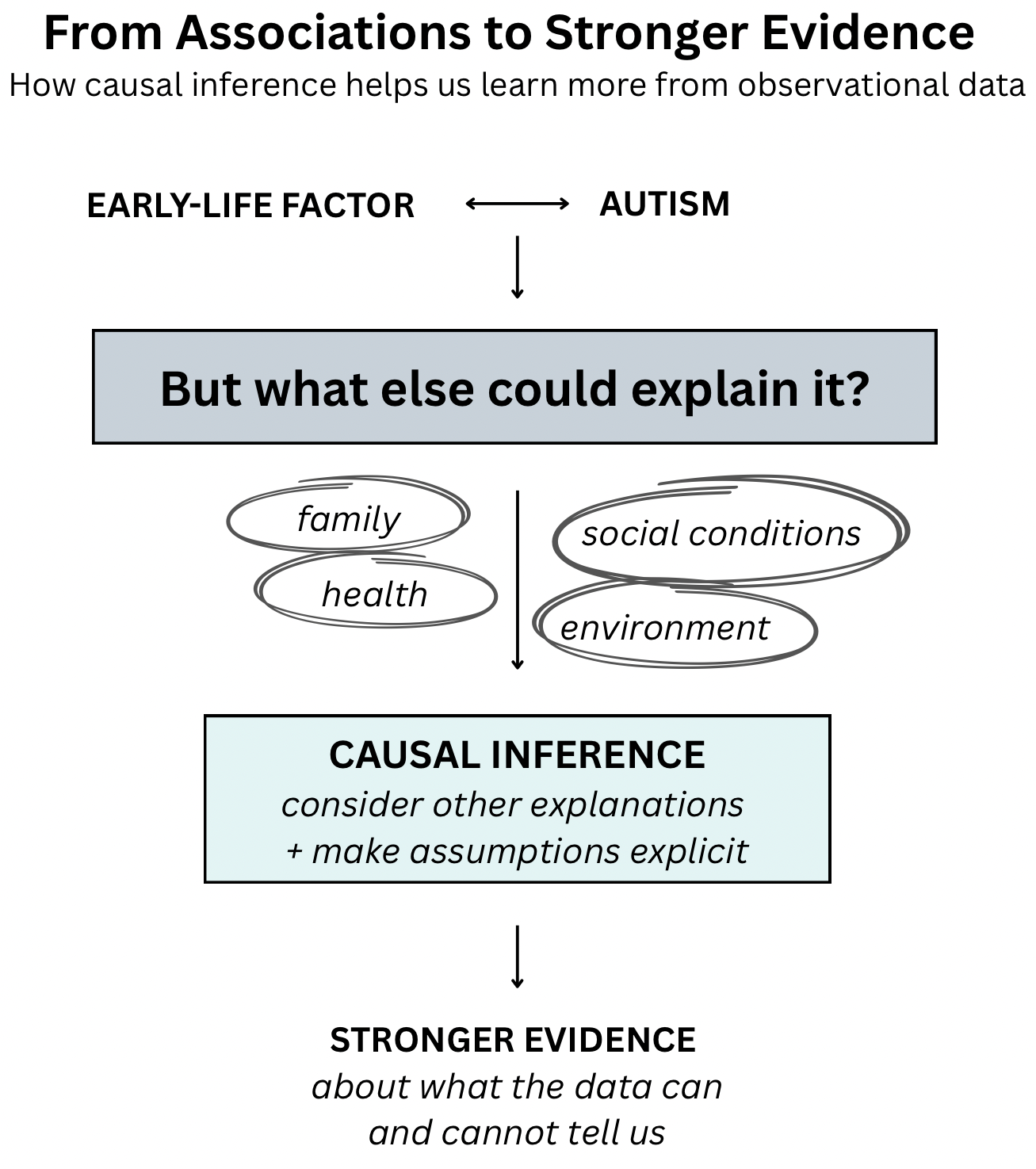
12 Sep 2026Understanding what may contribute to autism is challenging because early-life factors do not occur in isolation. Health conditions, medications, environmental exposures, family characteristics, and social conditions can be interconnected, making it difficult to determine what an observed relationship actually means. Finding that a factor is associated with autism is therefore only the beginning of the scientific question.
We are using causal inference to examine these relationships more carefully. Rather than asking only whether two things occur together, we ask what the data can tell us about the potential contribution of a particular factor when other relevant explanations are considered. This requires researchers to think carefully about which factors should be included, how they may be connected, and what assumptions are necessary to draw conclusions from observational data.
Causal inference does not turn observational research into a randomized experiment or provide simple proof of cause and effect. Instead, it provides a more structured and transparent way to investigate causal questions. By making assumptions explicit and open to examination, we hope to strengthen both the evidence we produce and the conversation about what that evidence can—and cannot—tell us.